

Beautiful Traditional Bedroom Sets & Timeless Design Ideas
Table of Contents
Introduction
A well-made dresser can outlive three homes. That is the case for traditional bedroom sets: furniture built from solid hardwood, joined by hand-cut methods, and shaped by silhouettes that have stayed in favor for two centuries.
The risk is the showroom. Five identical pieces in one finish, a matching bedspread, and a mirror the size of a door can make even excellent furniture look stale. The solution is not to avoid traditional bedroom furniture. It is to choose it with care, scale it to the room, and style it with restraint.
This guide covers what defines a traditional style bedroom, how three-piece and five-piece sets differ, how to judge construction quality, how to measure for an oversized sleigh or poster bed, and how to build a modern traditional bedroom that feels calm instead of dated. You will also find color, textile, and lighting advice for warm wood interiors.
Start with the room itself. If you have not measured yet, read our guide to the bedroom floor plan first. Heavy furniture punishes a bad plan.
1. What Defines a Traditional Style Bedroom?

A traditional style bedroom draws on 18th- and 19th-century European and American furniture. Think Georgian, Federal, and French Provincial, simplified for modern life. Three traits set it apart.
Architectural Lines and Classic Silhouettes
Traditional furniture borrows from architecture. You see it in a crown molding on a dresser, a raised panel on a headboard, a turned post on a bed, and a bracket foot at the base of a chest.
The classic bed shapes are the sleigh (a scrolled headboard and footboard), the poster (four tall posts), the panel, and the upholstered wingback. Nightstands carry curved legs, drawers with a bow front, and a modest apron. The lines curve but do not fuss.
Rich Wood Tones and Tactile Finishes
Wood is the point. Cherry runs red and deepens with age. Walnut leans brown with violet undertones. Oak is golden and strongly grained. Maple is pale and fine. Mahogany is dark and red.
Finishes matter as much as species. A satin or low-sheen finish shows the grain and feels smooth to the hand. A high-gloss finish hides it, and looks dated. Look for finishes that let you see the wood.
Symmetry and Visual Balance
Traditional rooms are balanced. The bed centers on its wall. Matching nightstands and lamps flank it. A dresser and a mirror sit opposite, centered. The eye rests because it knows where to go.
Symmetry is also why traditional bedroom ideas work well in rooms with a clear focal wall. A standard 12×14 room suits it.
2. Breaking Down Traditional Bedroom Sets (3-Piece vs. 5-Piece)

Traditional bedroom sets come in tiers. Each one trades floor space and budget for storage and presence.
| Set | Pieces | Typical sizes | Best for |
|---|---|---|---|
| 3-piece | Bed, 2 nightstands | Nightstand 24 to 30 in wide, 16 to 18 in deep | Rooms of 10×10 to 12×12 |
| 5-piece | Bed, 2 nightstands, dresser, mirror | Dresser 60 to 72 in wide, 18 to 20 in deep, 32 to 36 in tall | Rooms of 12×14 and up |
| 6-piece | 5-piece plus a chest | Chest 36 to 40 in wide, 48 to 54 in tall | Rooms of 14×16 and up |
The Core 3-Piece Set (Bed + Two Nightstands)
The three-piece set is the sound choice for most buyers. You get the bed, which anchors the room, and two matching nightstands, which create the symmetry. You skip the dresser and mirror, which take the most floor space.
Buy this set first if the room is modest. Add storage later in a different piece. A tall chest, a built-in wardrobe, or a vintage dresser can all work.
If your room is an 8×10 or 10×10, read our small bedroom layout guide before you choose a bed. A heavy sleigh bed can overwhelm a small room.
The Full 5-Piece and 6-Piece Suites
A five-piece suite adds a dresser and a mirror. Six pieces add a chest. The set arrives coordinated, with one finish and one hardware style, and costs less than buying each piece separately.
That convenience has a price. A 72-inch dresser and a 36-inch-tall mirror dominate a wall. A chest adds another tall mass. Together they can fill a 12×14 room.
Before you buy a full suite, check three things:
- Floor space. You need 36 to 42 inches in front of the dresser and chest.
- Wall space. A dresser plus mirror needs a clear wall of about 6 feet.
- Storage needs. A 60-inch, six-drawer dresser holds most wardrobes. You may not need the chest.
Solid hardwood suites typically run from a few thousand dollars into five figures. Veneered and engineered sets cost less. The next section explains what you pay for.
3. How to Spot Quality in Traditional Bedroom Furniture
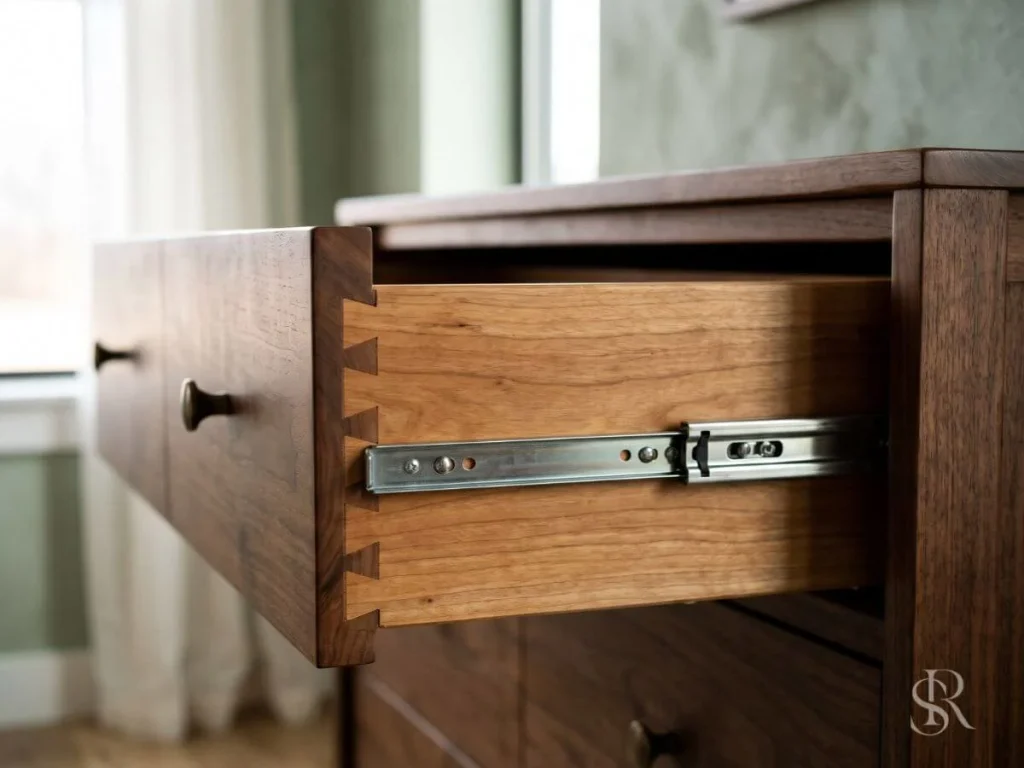
Traditional bedroom furniture earns its price in the parts you cannot see from the doorway. Learn to check them.
Solid Hardwood vs. Veneer and Engineered Core
Solid hardwood means boards cut from a single species, such as oak, maple, cherry, or walnut. It resists wear, can be sanded and refinished, and lasts for decades.
Quality depends on drying. Furniture-grade lumber is kiln-dried to a moisture content of about 6 to 8 percent. Wood that is wetter shrinks and cracks in a heated home. Ask the retailer how the lumber was dried.
Veneer is a thin slice of real wood glued over a core. Good veneer over plywood is stable and often looks excellent, especially on large panels such as headboards and tops. Thin veneer over particleboard or MDF is the weak option. It chips at edges and cannot be refinished.
Labels can mislead:
- “Solid wood” should mean solid throughout. Ask whether it applies to the whole piece or only to the frame.
- “All wood construction” can include plywood and veneer.
- “Wood products” or “engineered wood” usually means MDF or particleboard.
Test the piece. Lift a corner. A solid wood nightstand typically weighs 40 to 60 pounds. A hollow one feels light. Check the back panel and the underside of the top, too. They should be finished, not stapled cardboard.
Drawer Construction and Hardware Details
Open every drawer. It tells you more than the finish does.
- Joinery. Look for dovetail joints at the front and back corners. They interlock like fingers and hold for generations. Stapled or glued butt joints fail.
- Drawer sides. Solid wood about 1/2 inch thick is a good sign. Thin plywood or particleboard is not.
- Glides. Full-extension ball-bearing glides, ideally soft-close, let you reach the back. Wooden center glides are acceptable in older designs.
- Dust panels. A thin panel between drawers keeps dust out of the lower ones.
- Hardware. Solid brass or bronze pulls feel heavy and take a patina. Plated zinc feels light and flakes.
- Frame. Mortise-and-tenon joints in the case and bed frame hold best. Check that bed rails attach with bolts and steel brackets, not just wood pegs, and that queen and king frames include a center support rail with at least two legs.
A piece that passes these checks will serve you for decades, even when the finish wears.
4. Traditional Bedroom Design Ideas: Styling Without Looking Dated
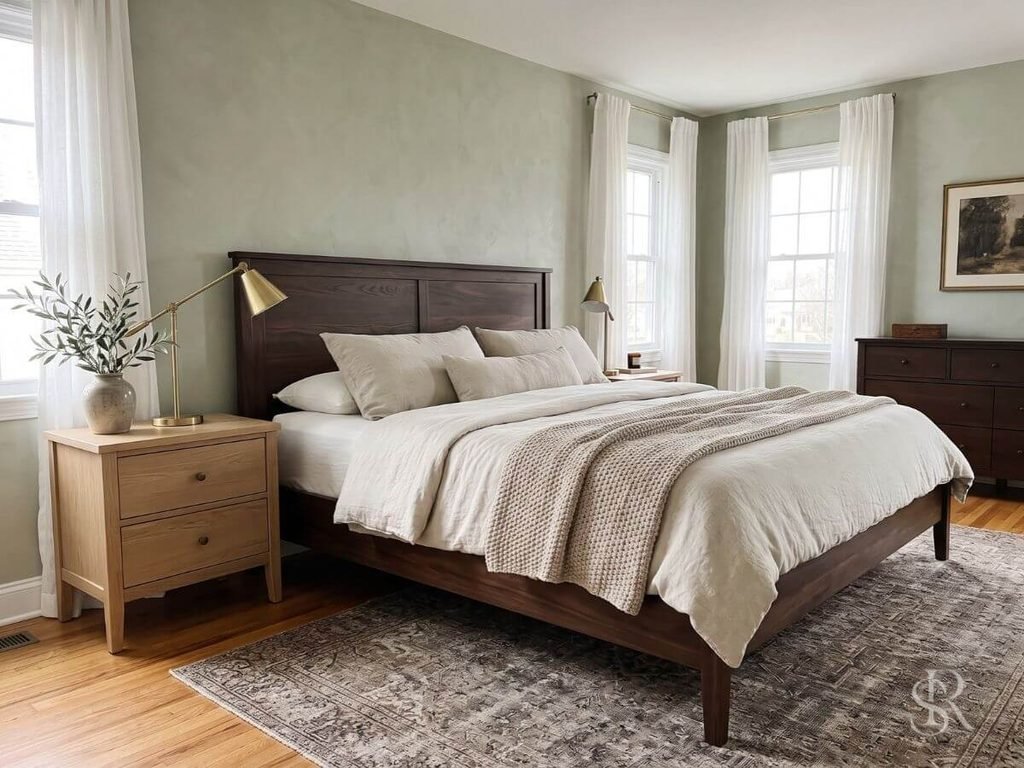
The best traditional bedroom design ideas treat the furniture as the heirloom and everything else as editable.
Embracing the “Modern Traditional Bedroom” Balance
A modern traditional bedroom keeps the classic silhouettes and drops the clutter. The bed has a gentle curve. The walls are quiet. The bedding is plain. One or two pieces carry the history, and the rest stay simple.
Try this formula:
- One statement bed in a classic form
- Solid-colored bedding in linen or cotton
- Lamps with clean lines in brass, ceramic, or bronze
- Plain, tailored window treatments
- No more than two wood tones and one metal
This is how you get Quiet Luxury from traditional furniture. You keep the craft and lose the fuss.
Breaking Up the Showroom Match
A matching set looks like a showroom. A collected room looks like a home.
Break the match in small steps:
- Buy the three-piece set and add a vintage or antique dresser in a similar wood family.
- Pair a dark bed with nightstands one shade lighter.
- Skip the matching dresser mirror and hang a round or arched mirror in its place.
- Use a bench in upholstery, not wood, at the foot of the bed.
- Choose two different lamps of the same scale and finish.
Keep undertones consistent. Red woods like cherry pair with other warm tones. Mixing a yellow oak with a violet-brown walnut tends to clash.
Scaling Heavy Furniture for Standard Rooms
Traditional pieces are large. Scale decides whether they feel grand or cramped.
Measure the whole bed, not the mattress. Typical outside dimensions:
| Bed | Typical outside width | Typical outside length | Height |
|---|---|---|---|
| Queen sleigh | 66 to 70 in | 86 to 92 in | Headboard 45 to 60 in |
| King sleigh | 82 to 86 in | 88 to 92 in | Headboard 45 to 60 in |
| Queen poster | 64 to 68 in | 84 to 86 in | Posts 60 to 84 in |
| King poster | 80 to 84 in | 84 to 88 in | Posts 60 to 84 in |
These are typical figures. Check the maker’s specification sheet. A sleigh footboard adds 6 to 12 inches to the length. Tall posts need ceiling height: a post of 84 inches wants a ceiling of at least 9 feet to feel proportioned.
Now test the plan:
- A queen sleigh bed in a 10×10 room leaves about 26 inches on each side and 30 inches at the foot. That is below the comfortable 30-inch standard on the sides.
- A king poster bed in a 12×14 room leaves about 31 inches on each side and about 80 inches at the foot. That works.
Also measure the route. Dressers can be 70 inches wide and weigh well over 100 pounds. Check doorways, stair turns, and hall widths before delivery.
A good working rule is to keep roughly 60 percent of the floor open. If a suite breaks that rule, choose the three-piece set.
5. Traditional Bedroom Decor: Color Palettes, Textiles, and Lighting

Good traditional bedroom decor supports the wood. Keep the palette soft, the textiles layered, and the light warm.
Timeless Wall Colors That Flatter Warm Woods
Choose a wall color that contrasts with the wood’s undertone, not one that repeats it.
- Cherry and mahogany (red): soft sage, gray-green, or warm cream. Green balances red.
- Walnut (brown-violet): warm white, soft greige, or muted blue-gray.
- Oak (golden): gray-blue, soft taupe, or deeper olive.
- Maple (pale): nearly any warm neutral, or a deeper charcoal for contrast.
For a richer room, paint the walls a deep tone such as navy or olive and keep the ceiling and trim lighter. Test every sample next to the wood.
Layered Textiles and Rugs
Layering adds comfort and tames heavy furniture.
- Bedding. Use a washed linen duvet cover in a solid color, a cotton matelassé coverlet, and a wool throw at the foot.
- Pillows. Stop at two sleep pillows, two Euro shams, and one lumbar.
- Rug. A wool rug in a vintage-style pattern grounds the bed. Use 8×10 feet for a queen and 9×12 for a king. Extend it at least 24 inches past each side.
- Curtains. Hang pleated or tailored panels from ceiling to floor. Choose a width of two times the window.
A patterned rug is the one place where traditional decor can carry real pattern. Keep the bedding solid.
Warm, Layered Lighting
Use three layers.
- Ambient. A flush mount or small chandelier sets the base. Size a fixture by adding the room’s width and length in feet. A 12×14 room suits about a 26-inch fixture. Aim for 10 to 20 lumens per square foot.
- Task. Use table lamps 28 to 30 inches tall, or brass swing-arm sconces mounted 54 to 60 inches from the floor. Choose 400 to 600 lumens at 2700K.
- Mood. Add a small lamp or dimmed bulbs for evening.
Put every layer on a dimmer. Warm light flatters wood and keeps the room soft.
For more ideas on how to style the room beyond furniture, browse our full collection of bedroom ideas.
Frequently Asked Questions

What comes in a traditional bedroom set?
A three-piece set includes a bed and two nightstands. A five-piece set adds a dresser and a mirror. A six-piece set adds a chest. All pieces share one wood and finish. Some sets also include a bench.
Is solid wood bedroom furniture worth the cost?
For pieces you will keep for ten years or more, yes. Solid hardwood can be sanded, repaired, and refinished. It resists dents and holds joints. Veneered furniture can be a good value if it uses a plywood core and quality joinery. Avoid thin veneer over particleboard.
What size room do I need for a five-piece set?
Plan on at least 12×14 feet for a queen and 14×16 feet for a king. You need 30 inches beside the bed, 36 inches in the main walkways, and 36 to 42 inches in front of the dresser.
How do I keep a traditional bedroom from looking dated?
Simplify everything except the furniture. Choose solid-colored linen bedding, clean-lined lamps, and calm wall colors. Mix one or two pieces from other sources. Skip the matching bedspread set. Keep metal finishes to one.
Conclusion: Investing in Pieces Built to Last
Traditional bedroom sets reward patience. Measure the room first. Look inside the drawers. Choose solid wood where it counts and edit everything around it.
A bed built from kiln-dried hardwood and joined with real joinery will outlast most trends. Pair it with quiet color, layered textiles, and warm light, and it will feel less like a showroom and more like a haven.
Begin with the bed. Everything else can follow, one considered piece at a time.


One Comment
Comments are closed.