

27 Refined Bedroom Ideas Designed for Rest,Warmth, and Quiet Luxury
Table of Contents
Introduction
You spend a third of your life in your bedroom. Most people design it for the other two-thirds.
A restful bedroom has one job. It slows you down at the end of the day. Every object in the room either helps or gets in the way: the bed, the light, the wall color, the weight of a blanket across your legs.
Quiet luxury is the design approach built on that idea. It skips logos, trends, and clutter. It favors what you can feel. Washed linen. Wool underfoot. Oak that warms under your hand. Colors stay soft and surfaces stay clear. The quality shows in the material, not on a label.
This guide gives you 27 bedroom ideas across seven areas: layout, color, bedding, lighting, furniture, room size, and finishing touches. Each idea comes with real numbers, such as clearances, fabric weights, and lumens, so you can plan with a tape measure instead of a hunch.
The principles hold in a large suite or a 10-by-10 room. Use these master bedroom ideas as a full plan, or take one section and start there. Modern bedroom design, done well, removes more than it adds.
1. Master Bedroom Layouts: Balancing Scale and Intimacy
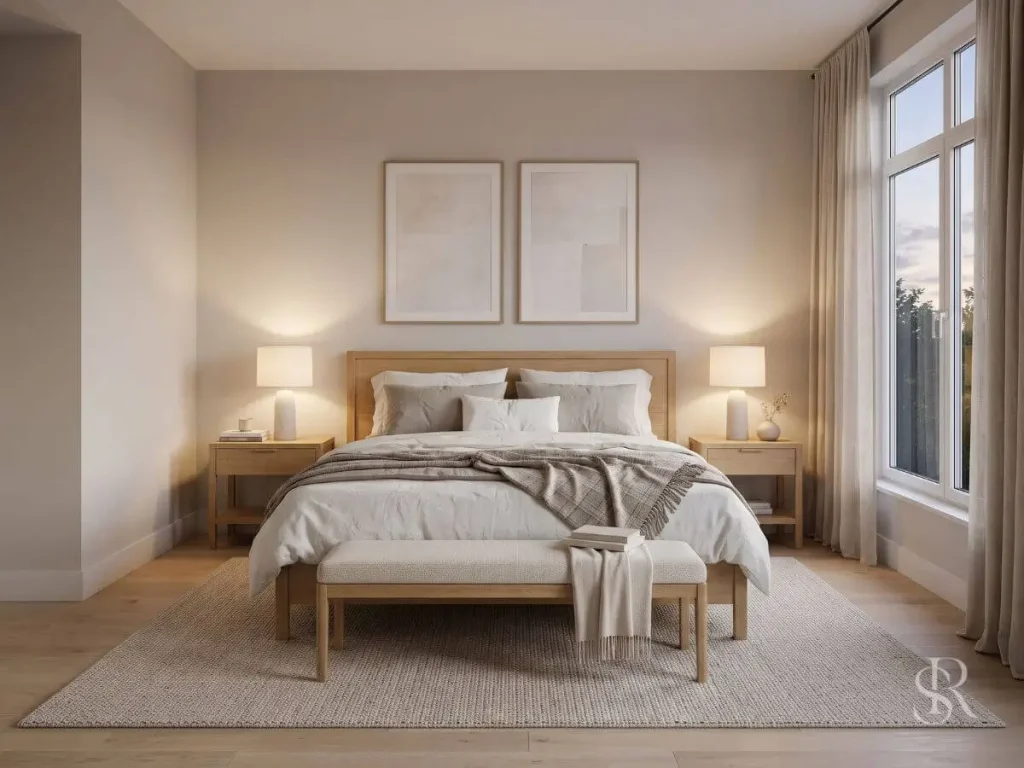
Layout comes first. No paint color or throw pillow can fix a bed in the wrong place. Good master bedroom ideas start with a floor plan.
Idea 1: Center the bed on the longest solid wall
Place the headboard on the wall with no windows or doors. Center it. A king mattress measures about 76 by 80 inches. A queen measures 60 by 80. Both need room to breathe.
As a rule, a queen fits comfortably in a 10-by-10 room. A king wants about 12 by 12. Smaller rooms can hold a king, but you lose your walkways.
Idea 2: Give each side equal weight
Symmetry calms the eye. Set a matching nightstand on each side of the bed. Choose a top height within two inches of the mattress top, usually 24 to 28 inches. Aim for 20 to 26 inches wide.
Two matched nightstands also give each sleeper the same reach to a lamp, a glass of water, and a book.
Idea 3: Keep 36 inches clear on main paths
Walkways need 36 inches. Leave at least 24 inches on each side of the bed, and 36 where you can. Allow 36 to 42 inches in front of a dresser, because an open drawer takes about 20 inches of floor.
Stand in the room with a tape measure before you buy anything. Mark the footprints with painter’s tape. You will see the problem before you pay for it.
Idea 4: Build a quiet zone at the foot of the bed
Add an upholstered bench at the foot. Choose one 16 to 20 inches deep and about 18 inches tall. Make it two-thirds to full width of the bed. It gives you a place to sit while you put on shoes, and it frames the bed.
If the room allows, set a reading chair in a corner with a small side table. Keep 36 inches between the bench and the nearest wall or dresser.
2. Timeless Bedroom Color Palettes (Beyond Stark White)

Stark white reads cold and flat at night. Warmer color gives the eye a place to rest. These bedroom color ideas work because they stay close to nature: stone, clay, leaf, and shadow.
Idea 5: Start with alabaster
Alabaster is white with a drop of cream. It reflects light without glare. Sherwin-Williams Alabaster has a light reflectance value (LRV) of about 82, so it brightens a dim room and still feels soft. Benjamin Moore Pale Oak is a good cousin if you want a touch more gray.
Idea 6: Move to taupe and mushroom gray
Soft taupe and mushroom gray add warmth without color. They hide shadows and suit most wood tones. Look for an LRV between 50 and 65.
Test each sample on two walls. Look at it at 8 a.m. and again at 8 p.m. Undertones shift with the light.
Idea 7: Add earthy depth in one place
Olive green, muted terracotta, and deep charcoal bring weight and mood. Use them on one wall, or on the whole room if you want a cocoon.
Dark colors with an LRV under 15 absorb light. Compensate with 2700K bulbs and a pale linen on the bed. Keep the ceiling a few shades lighter than the walls.
Idea 8: Ground the bed with a two-tone wall
Paint the headboard wall two to three steps deeper than the other walls, using the same paint strip. The bed gains a backdrop and the room keeps its light.
For a calmer version, paint the lower 60 percent of the wall in the deeper shade. Finish with a thin wood rail or a crisp edge in the lighter tone.
3. Layered Bedding: The Anatomy of Understated Comfort
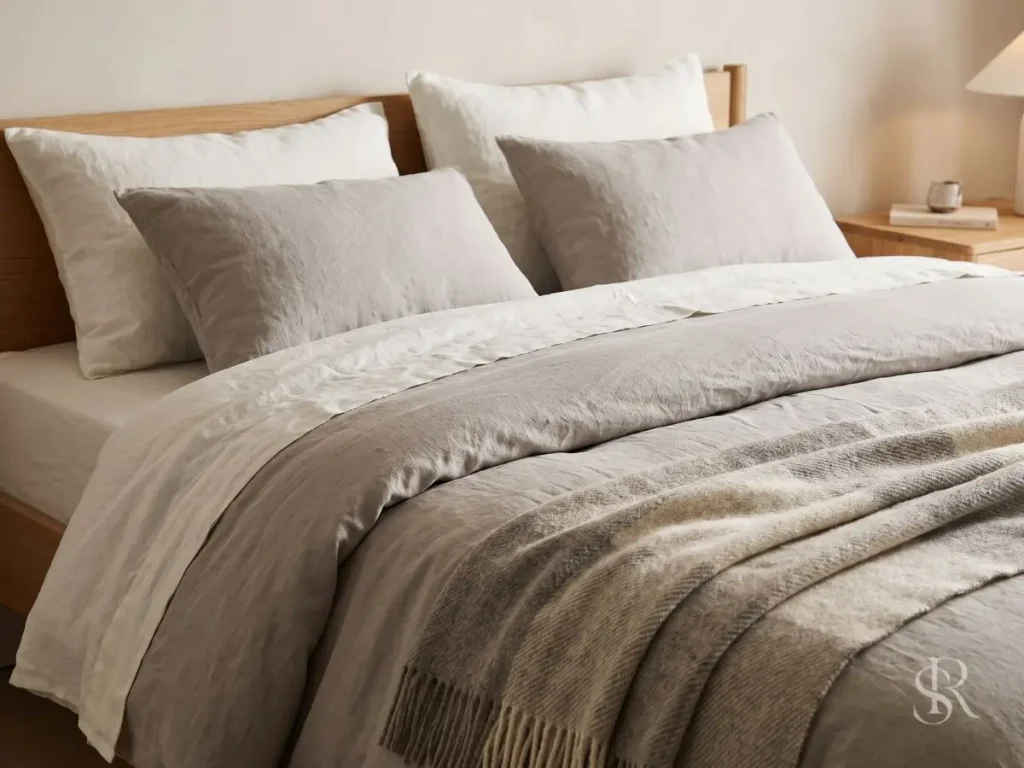
Bedding is where quiet luxury is easiest to feel. Choose fewer pieces and better fabrics. Texture does the work that pattern does in a busier room.
Idea 9: Choose washed Belgian linen
Washed linen softens with every wash. It breathes in summer and holds warmth in winter. Look for 150 to 190 grams per square meter (GSM) for sheets and duvet covers. Lighter weights, around 120 to 150 GSM, suit hot sleepers.
Linen wrinkles. That is part of its charm. Embrace a relaxed look and skip the iron.
Idea 10: Pair it with organic long-staple cotton and a wool throw
Long-staple cotton, such as Pima or Egyptian, makes a smoother, stronger yarn. A 300 to 400 thread count percale feels crisp. A sateen weave feels warmer and silkier.
Fold a wool throw across the foot of the bed. A 50-by-70-inch throw weighing 2 to 3 pounds adds warmth on cool nights and a soft edge by day.
Idea 11: Use fewer pillows, in three sizes
Most beds carry too many pillows. Cap the count. For a queen, use two sleeping pillows (20 by 26 inches), two Euro shams (26 by 26), and one lumbar (12 by 22). For a king, use two king pillows (20 by 36) in place of the sleeping pair.
Keep the shams in solid colors close to the duvet. A single textured lumbar adds interest.
Idea 12: Hang floor-to-ceiling linen curtains
Mount the rod just below the ceiling or crown molding. It makes the ceiling look taller. Choose panels two to two-and-a-half times the width of the window. Let the hem sit about a half inch above the floor.
Ask for blackout lining. An interlined panel, which adds a middle layer of fabric, blocks light and softens street noise. It will not silence a busy road, but you will notice the difference.
4. Modern Bedroom Lighting: Designing Three Practical Layers
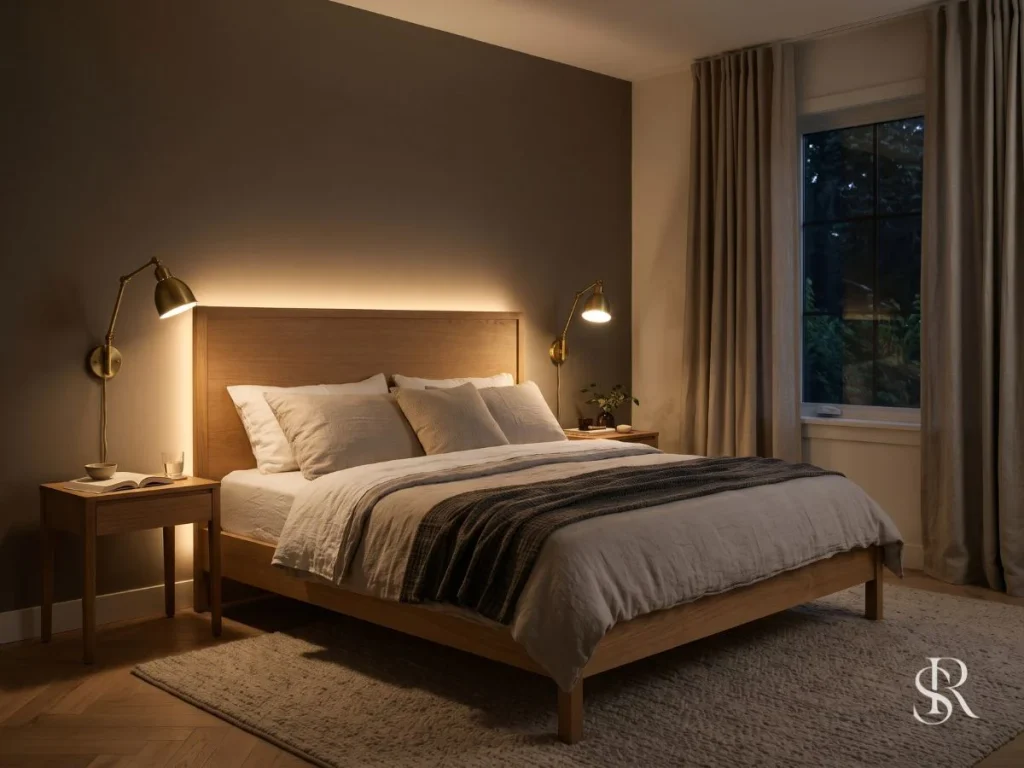
One ceiling fixture cannot light a bedroom well. Use three layers, and put each on its own dimmer. This is the quickest upgrade in modern bedroom design.
Idea 13: Light the room softly from above
Plan for 10 to 20 lumens per square foot. A 14-by-14-foot room (196 square feet) needs roughly 2,000 to 4,000 lumens in total. A 60-watt-equivalent LED bulb gives about 800.
Choose a plaster or fabric flush mount that diffuses light. Or hide LED strips in a cove along the ceiling. Set the color temperature at 2700K.
Idea 14: Add task light you can control from bed
Install articulated brass sconces on each side. Mount them so the center of the fixture sits 54 to 60 inches from the floor. Choose bulbs of 400 to 600 lumens at 2700K. The arm should swing to the page, then back to the wall.
If you prefer table lamps, set the bottom of the shade at eye level when you sit up in bed. That keeps the bulb out of your sight line.
Idea 15: Wind down with low accent light
Use a third layer at 100 to 200 lumens and 2200K. Place a strip behind the headboard, under a floating nightstand, or inside a closed cabinet. The glow bounces off the wall and washes out harsh edges.
This layer is the one you will use most. Turn the other two off an hour before bed.
Idea 16: Dim everything and pick high-CRI bulbs
Put every layer on a dimmer. Choose bulbs with a color rendering index (CRI) of 90 or higher. At that level, linen, wood, and skin look true.
5. Intentional Furniture and Tactile Materials
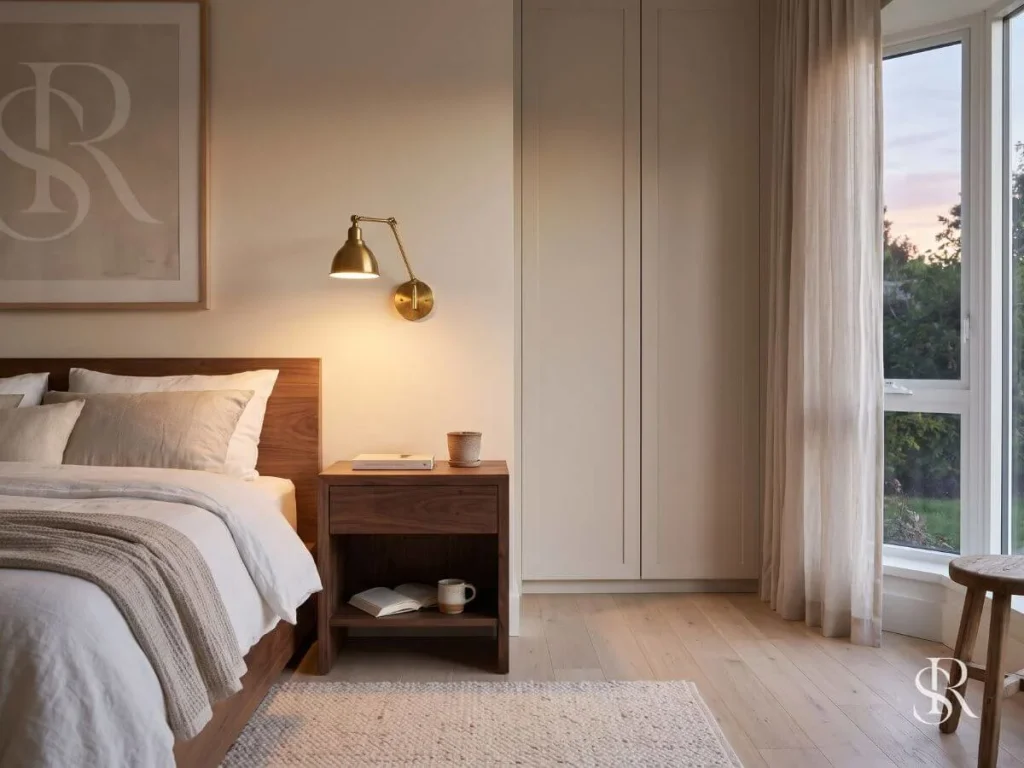
Few pieces, made well, set the tone. Buy furniture to keep for decades.
Idea 17: Choose solid wood nightstands
Solid oak or walnut outlasts composite. Scratches sand out. Dovetailed drawers glide for years. Composite chips at the edge and swells with moisture.
Find a piece with a clean profile and a single drawer or a closed door. The grain is all the decoration it needs.
Idea 18: Hide storage behind closed doors
Visual noise keeps the mind alert. Closed cabinetry quiets it. Build wardrobes 24 inches deep with flush, handleless doors that open with a press. Paint them the same color as the wall so they disappear.
Floating nightstands free the floor and make the room feel larger. Mount the top at mattress height.
Idea 19: Pick a low, deep dresser
Choose a dresser 18 to 20 inches deep and 30 to 36 inches tall. A low profile leaves room for art above it. Place a single tray on top and leave the rest bare.
Idea 20: Lay a wool rug that extends past the bed
Wool is dense, durable, and kind to bare feet. Choose a flat weave or a low pile of about half an inch, and add a rug pad.
Size matters more than pattern. The rug should extend at least 18 to 24 inches past the sides and foot of the bed. For a queen, choose 8 by 10 feet at minimum, and 9 by 12 for a fuller look. For a king, choose 9 by 12 or 10 by 14.
6. Small vs. Large Bedroom Strategies

Room size changes the strategy. Small rooms need restraint. Large rooms need structure.
Idea 21: In a small room, store upward and underneath
Use the vertical space. Add 12-inch drawers under the bed. Hang a shelf above the door. Replace nightstands with floating shelves or narrow 16-inch tables.
Mount sconces on the wall to free the surfaces. Every inch of a nightstand top is worth keeping.
Idea 22: In a small room, keep the palette tonal
Paint the walls, trim, and ceiling in one color family, within about 10 points of LRV. Edges blur and the room reads as larger.
Use one pattern at most. Let texture carry the rest. These bedroom decorating ideas cost little and work in any square footage.
Idea 23: In a large suite, define three zones
Split the room into sleeping, sitting, and dressing. For the sitting zone, set two chairs about 36 inches apart with a 24- to 30-inch round table between them. Give the zone a 5-by-8-foot rug of its own.
Keep 36 inches clear between zones. Do not push everything against the walls. Furniture that floats makes a big room feel intentional.
7. Natural Accents and Finishing Touches

Finishing touches are the last 5 percent. They make the difference between a bedroom that looks furnished and one that feels finished. Stop before you think you should.
Idea 24: Set out a travertine tray
Travertine is cool to the touch and warm in color. A 10- to 12-inch tray on a dresser or nightstand holds a watch, a ring, and a small bottle. It also gives clutter a boundary.
Idea 25: Group matte ceramic vessels in threes
Choose three vessels in the same glaze and different heights, from about 6 to 14 inches. Odd numbers look natural. Matte surfaces absorb light, which keeps the shelf calm.
Idea 26: Add three architectural branches
Place three stems of olive, magnolia, or dried eucalyptus in a 20-inch vessel. Let them rise at different angles. Skip the flowers, which fade and demand attention.
Idea 27: Hang one large work of art
Skip the gallery wall. Hang a single piece, about two-thirds the width of the headboard. For a queen, that is roughly 40 inches wide. Center it 57 inches from the floor.
Choose a minimalist canvas or a black-and-white photograph in a thin oak frame. One quiet image beats a dozen busy ones.
Frequently Asked Questions
What makes a bedroom look luxurious yet cozy?
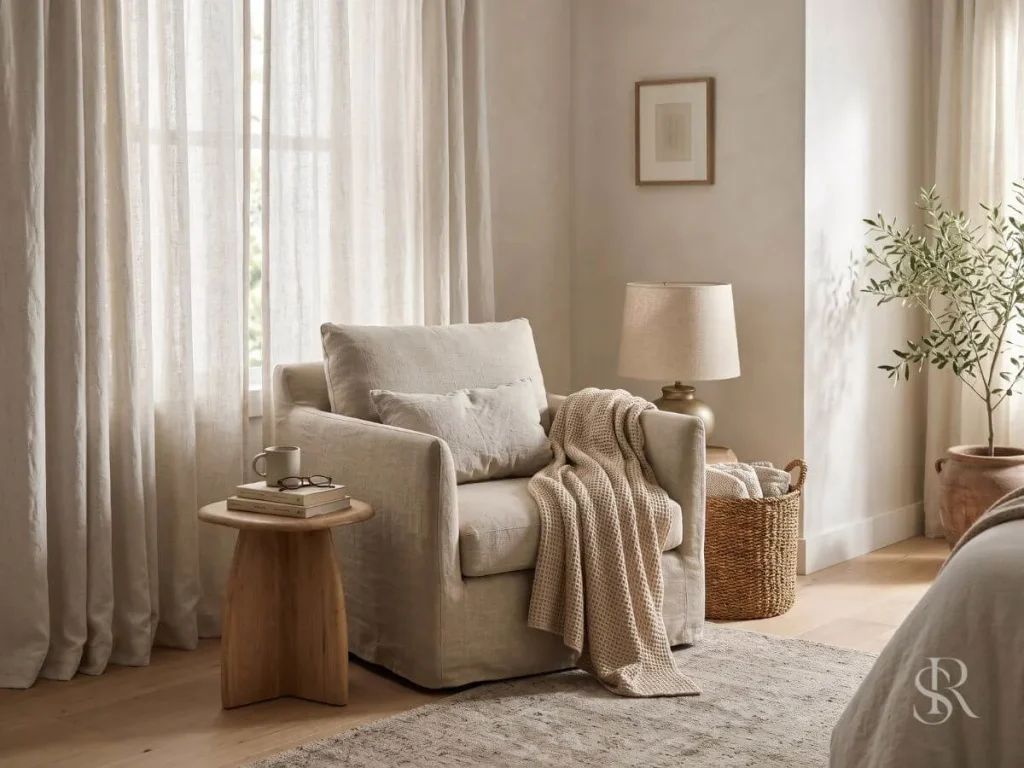
Material quality and restraint. Choose natural fabrics, such as linen, wool, and cotton, in a tight palette of three to four colors. Keep surfaces clear. Layer light at 2700K or warmer. Add one heavy texture, like a wool throw or a thick rug. Luxury reads from what you leave out. Warmth comes from what you can touch.
How do I choose the best paint color for low-light bedrooms?
Start with LRV. In a north-facing or dim room, choose a paint with an LRV above 60 if you want brightness, such as a warm alabaster. If you want a moody room, go deeper on purpose and add warm light. Test samples on two walls and watch them for a full day. Undertones, not the name on the can, decide the result.
What is the most functional furniture layout for a master bedroom?
Center the bed on the longest solid wall. Put a matching nightstand on each side. Keep 36 inches clear on all main paths and 36 to 42 inches in front of the dresser. Add a bench at the foot if the room allows. This layout works for nearly every rectangular room, and it adapts to both queen and king beds.
How can I achieve high-end bedroom decor on a budget?
Spend where you touch the room most: sheets and lighting. Add one good linen set before you replace the furniture. Swap harsh bulbs for dimmable 2700K ones. Paint the walls a warm neutral. Hang one large piece of art instead of many small ones. Then buy a solid wood nightstand or a wool rug when your budget allows.
Conclusion
A bedroom built for rest rests on three things: lasting pieces, honest materials, and soft light. Choose wood over veneer, linen over polyester, and one good lamp over three bad ones. The room will age well.
Do not redo the whole room this weekend. Pick one change. Swap your bulbs for 2700K dimmable ones, or replace your sheets with washed linen. Sleep one week with that change. Then decide what comes next.
Your bedroom does not need to be bigger or newer. It needs to be quieter.



3 Comments
Comments are closed.