
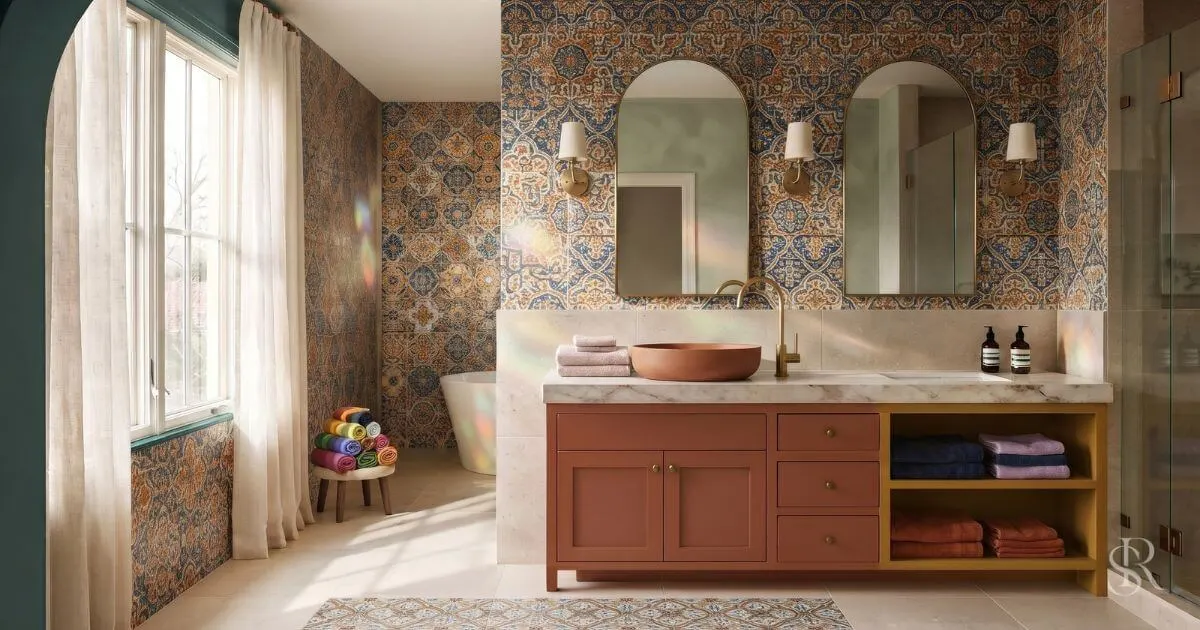
9 Best Bathroom Color Design Ideas for a Space You Will Love
Table of Contents
Introduction
A bathroom has at least six colored surfaces: walls, tile, grout, vanity, tub, and hardware. Most advice covers only the first. That is why so many bathrooms look assembled instead of designed.
This guide takes the full-room view. It gives you nine bathroom color design ideas that coordinate every surface, from tile and stone to a painted tub, plus a plain-spoken guide to which paint to use in a humid room. If you want help choosing a wall shade alone, our guide to bathroom paint color covers light reflectance values and specific shades. This article starts where that one ends.
The method is the 60-30-10 rule, applied to physical surfaces:
- 60% is the dominant surface: wall tile, plaster, or paint.
- 30% is the secondary mass: the vanity, the floor, or the tub.
- 10% is the accent: hardware, lighting, mirror frames, and textiles.
Colorful bathroom ideas work because they follow a ratio. Colored bathrooms fail when three colors share equal weight. Bathroom paint colors 2026 and beyond lean toward earthy, muted, tonal palettes, and that suits Quiet Luxury: depth through material, not noise.
1. Curated Multi-Surface Bathroom Color Palette Ideas (Ideas 1–4)
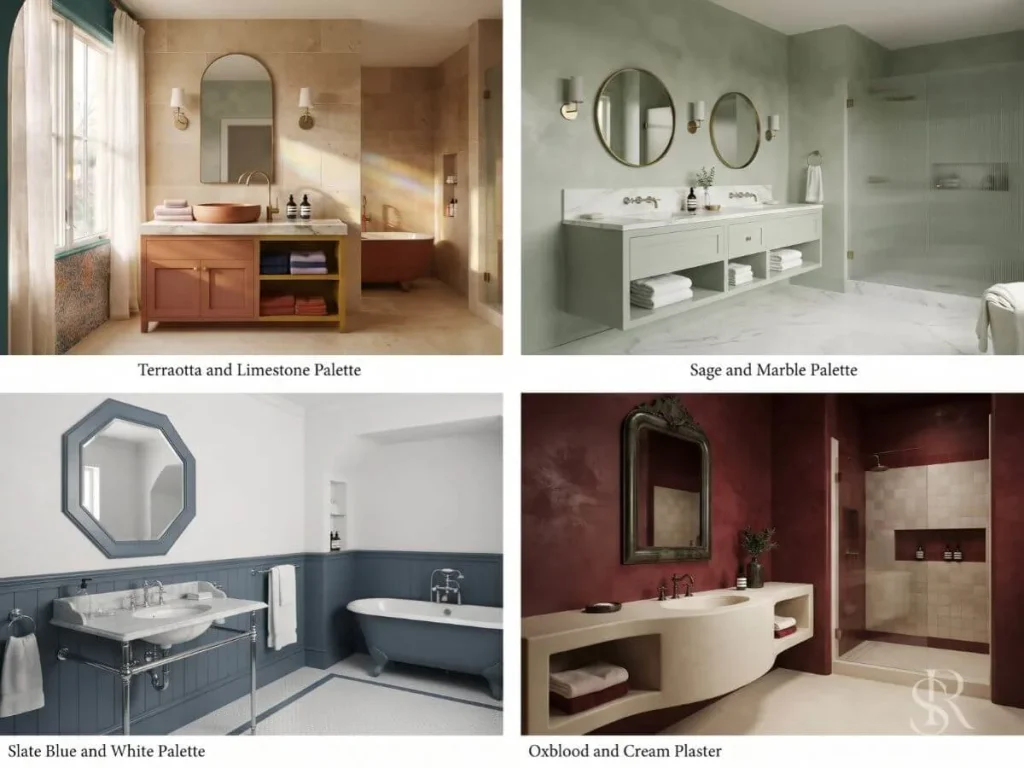
These four bathroom color palette ideas each assign a color to every surface. Use them as complete recipes.
1. Warm Terracotta, Honed Limestone, and Unlacquered Brass
- 60%: honed limestone or limestone-look porcelain in 12-by-24-inch tiles, on the floor and the wet wall.
- 30%: a terracotta vanity, or a terracotta tile apron on the tub.
- 10%: unlacquered brass faucets, sconces, and towel bar.
This scheme is warm and sunlit. Unlacquered brass has no protective coating, so it darkens and develops a patina with use. That change is part of the appeal. If you prefer a fixed finish, choose lacquered or PVD-coated brass.
Keep the grout within one to two shades of the limestone, so the floor reads as a single plane.
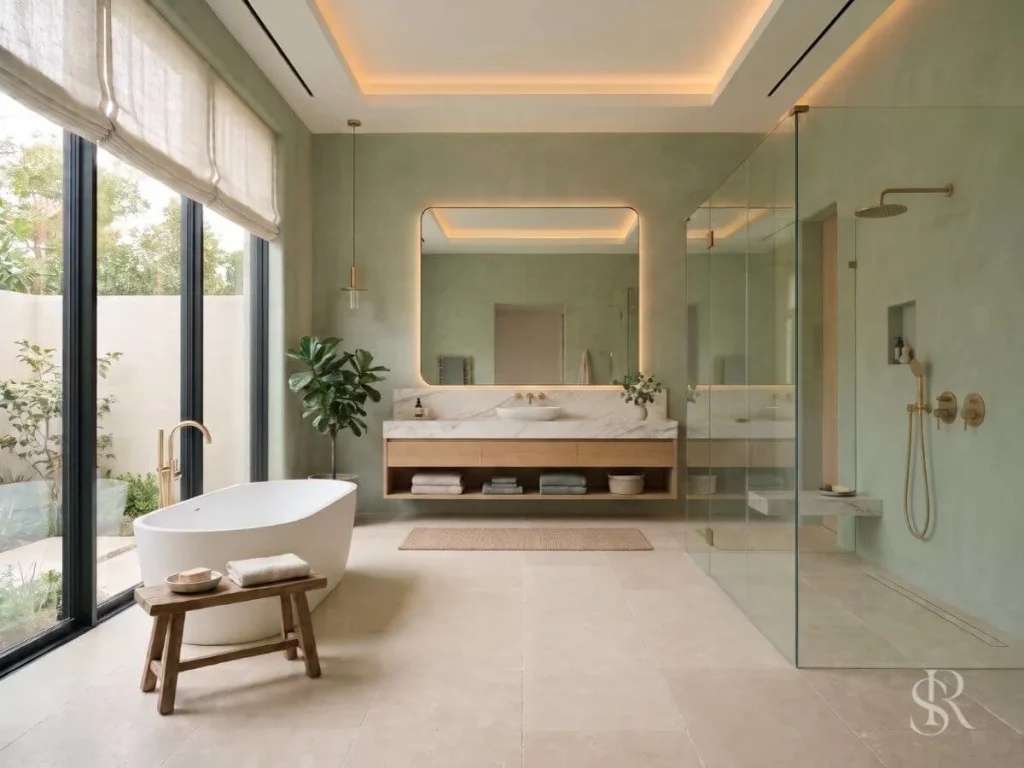
2. Muted Sage Cabinetry, Carrara Marble, and Warm Walnut
- 60%: Carrara marble or marble-look porcelain on the walls and floor, with soft gray veining.
- 30%: a muted sage vanity in a durable satin or semi-gloss enamel.
- 10%: a walnut mirror frame or a floating shelf, with brass or nickel hardware.
Sage is a green with gray in it, and it sits comfortably beside white marble. The walnut adds the warmth that marble lacks. Use a cabinet-grade enamel on the vanity, not wall paint. Enamel resists splashes and daily contact.
3. Dusty Slate Blue, Chalky White, and Polished Nickel
- 60%: chalky white walls and matte white wall tile, in a 3-by-12-inch or 4-by-12-inch format.
- 30%: a dusty slate-blue vanity or floor tile.
- 10%: polished nickel fixtures and a round mirror.
This is the coolest of the four. It suits north-facing bathrooms with plenty of daylight. In a room with little natural light, use 3000K bulbs to keep it from turning gray. Match every metal to one finish. Polished nickel and chrome look similar but not identical, so do not mix them.
4. Deep Oxblood, Cream Plaster, and Aged Bronze
- 60%: cream plaster or microcement on the walls. In wet zones, use a sealed, waterproof plaster system rated for showers.
- 30%: an oxblood vanity or floor tile.
- 10%: aged bronze fixtures and a candle-style sconce.
This is a powder room or primary bath scheme with real drama. The cream plaster keeps the red from closing in. Plaster needs a proper sealer, and its installer should confirm the system is rated for the splash zone.
2. Popular Tiny Bathroom Color Schemes & Elevated Themes (Ideas 5–7)
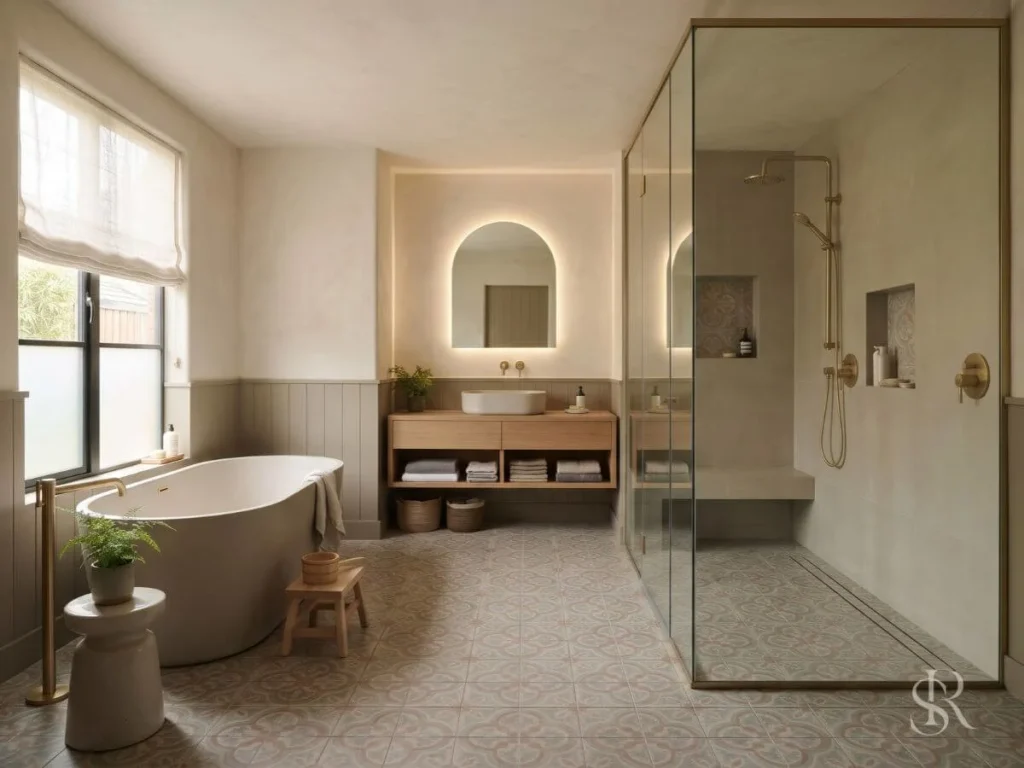
Small rooms punish contrast. Every hard line shrinks the space. These popular tiny bathroom color schemes use fewer breaks and quieter pattern.
A note on fun bathroom themes. A theme such as coastal, botanical, or vintage hotel can work in a small room, but carry it in art, textiles, and a single tile, not in paint. A theme built into every surface expires quickly.
5. Monochromatic Putty With Tone-on-Tone Grout
Choose one warm putty, a light, gray-beige, and use it across the tile, walls, and vanity, in different textures. The sameness makes the room look larger.
Grout is the detail that matters. Choose a grout within one to two shades of the tile. A tight match makes the surface read as continuous. Use rectified tile with a joint of 1/16 to 1/8 inch for the cleanest look. If the joint is wider than 1/8 inch, use sanded grout. Choose an epoxy or a stain-resistant cement grout in the shower, where mildew shows.
Add interest with texture: a ribbed tile, a honed counter, a linen shower curtain, a woven basket. The palette stays calm, and the surfaces carry variety.
6. The Two-Tone Wainscoting Split (36 to 42 Inches)
A two-tone split gives a small bathroom a horizontal line that anchors the room. Tile, beadboard, or paneling runs up the lower walls, and paint covers the upper walls.
- Height: 36 to 42 inches. At 36, the line aligns with a standard vanity height. At 42, it sits above the countertop and below the mirror.
- Cap: finish the tile with a bullnose or a 1-inch ledge so the transition looks intentional.
- Color: the lower section is darker or richer, and the upper is lighter. A deep sage below and a pale warm white above is a good pairing.
In terms of 60-30-10, the lower tile is 30 percent and the upper wall is 60 percent. The accent is the hardware.
Use a moisture-resistant matte or satin above the cap. Both resist steam, and the matte hides wall flaws.
7. Understated Patterned Tile With Quiet Walls
Pattern is the safest bold move in a small bathroom when you limit it to one surface. Choose an encaustic-look floor tile, 8 by 8 inches, in two muted tones. Keep the walls plain.
The rule is simple. Limit pattern to about 30 percent of the visible surface. On a 5-by-8-foot bathroom, the floor is about 40 square feet, which is a manageable size for a pattern.
Choose a floor tile rated for wet areas, with a DCOF of 0.42 or higher. Match one color in the pattern to the walls or the vanity, so everything ties together.
3. Bathtub Colors & Refinishing Ideas (Ideas 8–9)
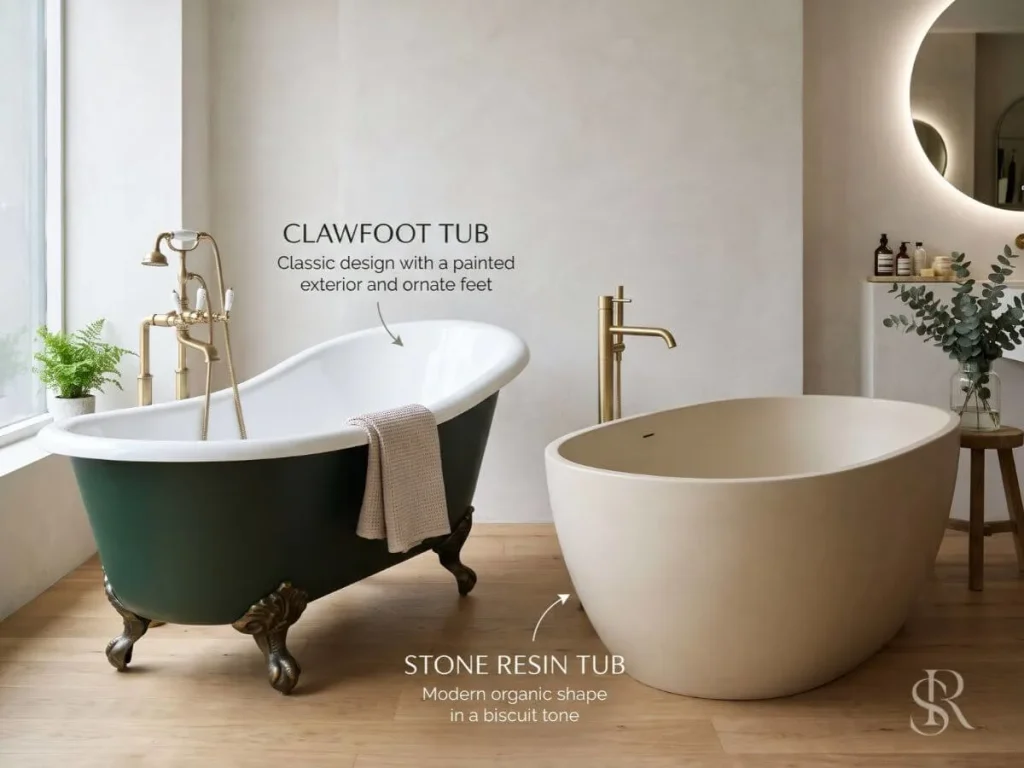
Bathtub colors are no longer limited to white. A tub is the largest object in the room, so its color sets the tone. For a full guide to tub shapes and sizes, see our article on bathroom bathtub designs.
8. Painted Exterior Cast-Iron and Clawfoot Tubs
A painted tub exterior is the quickest way to add color. The inside stays white porcelain, and the outside becomes a deep green, charcoal, navy, or oxblood.
These bathtub paint colors depend on the right product. Use two different coatings:
- Exterior: a urethane alkyd enamel. It cures to a hard, durable film that resists chips and scuffs.
- Interior: if you must recoat it, use a two-part epoxy tub refinishing system. Never use wall paint or enamel inside the tub.
Steps for the exterior:
- Degrease the tub and scuff-sand the surface.
- Apply a bonding primer.
- Apply two thin coats of enamel, observing the recoat time on the can. Alkyd enamels often need 4 to 8 hours between coats.
- Let the paint cure fully before the tub sees water.
Expect the finish to need touch-ups over time. A color that matches the vanity or the door of the room ties the scheme together.
9. Warm Stone-Tinted and Biscuit Solid-Surface Tubs
Biscuit, bone, and putty tubs are a soft alternative to stark white. They look warmer next to limestone, plaster, and brass.
Solid-surface and stone-resin tubs carry their color through the material, so chips do not show. Many have a matte finish and hold heat well.
Match the tub to the tile and grout, not to the fixtures. A white fixture next to a biscuit tub can look dirty. Choose bone or off-white sinks and a warm-toned tile to keep the palette consistent.
Because the color is built in, you cannot repaint a solid-surface tub easily. Choose carefully, and sample the tub beside the tile before you order.
4. What Type of Paint for a Bathroom? Brand & Formula Guide
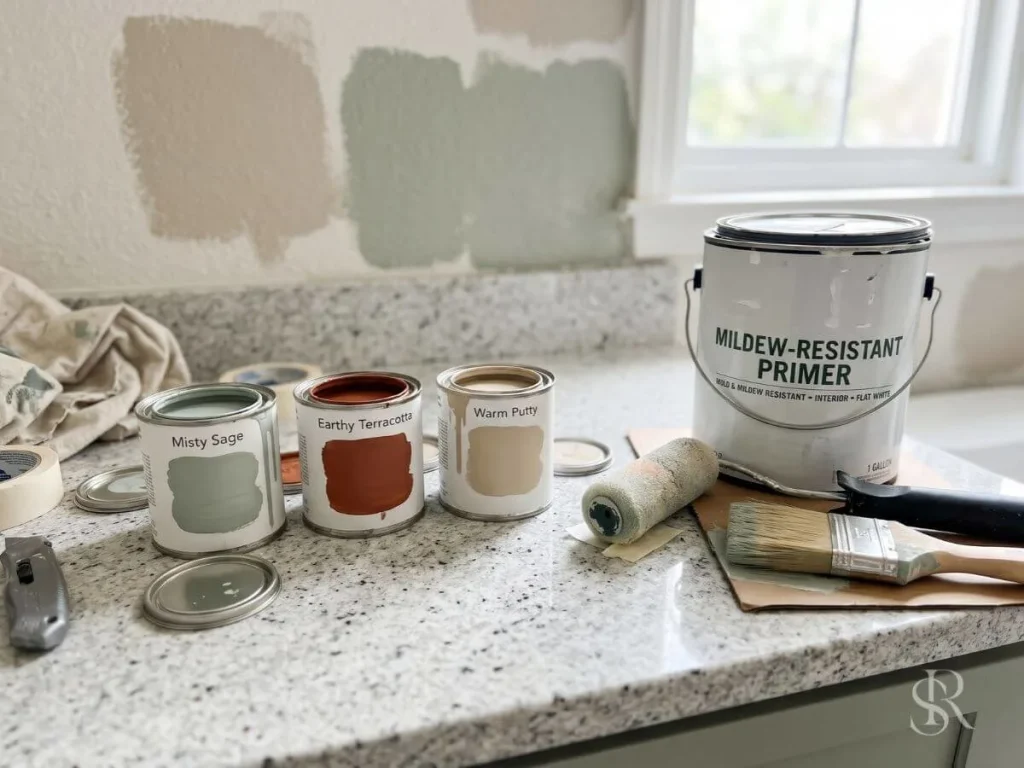
Color choices fail when the paint fails. If you are asking what type of paint for a bathroom, the answer is a 100 percent acrylic latex that is labeled mildew resistant, in a satin or semi-gloss sheen, or in a moisture-resistant matte.
The recommended paint for a bathroom depends on the surface. Walls take a washable acrylic. Trim and doors take semi-gloss. The tub exterior takes urethane alkyd enamel.
Benjamin Moore vs. Sherwin-Williams vs. Behr (Comparison Table)
Three brands dominate the shelf. Benjamin Moore bathroom paint centers on Aura Bath & Spa. Sherwin-Williams offers Duration Home. Behr bathroom paint centers on Premium Plus, used with Behr’s Kitchen, Bath & Trim stain-blocking primer and sealer (No. 75).
| Product | Finish options | Mildew resistance | Dry / recoat time | Best use case | Price tier |
|---|---|---|---|---|---|
| Benjamin Moore Aura Bath & Spa | Matte only | Mildew-resistant coating; zero VOC | 1 hour / 1 hour | Walls and ceilings in full baths where color depth matters | Premium |
| Sherwin-Williams Duration Home | Flat, matte, satin, semi-gloss | Anti-microbial agents inhibit mold and mildew on the paint film | Quick return to service, as little as 2 hours; check the can for recoat | Busy family bathrooms that need stain resistance | Upper mid |
| Behr Premium Plus (with Kitchen, Bath & Trim Primer No. 75) | Flat, eggshell, satin, semi-gloss | Dry paint film is mildew resistant | 1 hour / 2 hours | Budget-conscious walls, trim, and doors | Value |
Price tier is relative, and prices vary by retailer and region. Dry and recoat times assume normal temperature and humidity. A cold or damp bathroom takes longer.
How to choose:
- Pick Aura Bath & Spa for rich, saturated color on walls and ceilings. It comes in matte only, so use a different product on trim.
- Pick Duration Home when you want a choice of sheens in one product line, from matte to semi-gloss.
- Pick Behr Premium Plus to save money on a larger project, and use the Kitchen, Bath & Trim primer under it on stained or glossy surfaces.
Prep, Primers, and Sheen Rules for High Humidity
Prep matters as much as the product.
- Fix the moisture first. Repair leaks and run the exhaust fan during showers and for 20 minutes after.
- Clean and kill mildew. Wash walls with a mildew remover and let them dry fully.
- Prime. Use a 100 percent acrylic, mildew-resistant primer on bare drywall, stains, and glossy surfaces.
- Caulk. Seal gaps at the tub, vanity, and trim with a mildew-resistant caulk.
- Apply two coats. Paint when the room is within the product’s temperature range. Aura, for example, lists 50 to 90 degrees Fahrenheit.
- Wait before scrubbing. Behr advises waiting two weeks before cleaning cured paint.
Sheen rules:
- Ceilings: moisture-resistant matte.
- Walls outside the shower: satin, or a moisture-resistant matte.
- Walls near the shower, trim, and doors: semi-gloss.
- Tub exterior: urethane alkyd enamel.
- Tub interior: two-part epoxy refinishing system only.
Frequently Asked Questions
What type of paint should I use in a bathroom?
Use a 100 percent acrylic latex labeled mildew resistant, in satin or semi-gloss. A moisture-resistant matte, such as Benjamin Moore Aura Bath & Spa, suits ceilings and low-splash walls. Prime bare or stained surfaces first.
Is Benjamin Moore Aura Bath & Spa worth the price?
For rich color on walls and ceilings in a full bath, many designers think so. It dries in 1 hour, can be recoated in 1 hour, and is mildew resistant. It is matte only, so you need a second product for trim. For a rental or a budget project, Behr Premium Plus is a sensible alternative.
Can I paint a bathtub?
You can paint the exterior of a cast-iron or clawfoot tub with a urethane alkyd enamel. The interior needs a two-part epoxy refinishing system, which is harder to apply and wears faster than porcelain. A professional refinisher gives the best result.
What are the most popular tiny bathroom color schemes?
Monochromatic putty with tone-on-tone grout, warm white with a single patterned floor, and a two-tone wainscot split at 36 to 42 inches. All three reduce visual breaks, and they keep a small room calm.
Conclusion: Designing Color Across Every Surface
A great bathroom is a set of decisions, not one. Pick your dominant surface and give it 60 percent. Assign the vanity, floor, or tub 30 percent. Save 10 percent for hardware and light. Match the grout to the tile, and choose paint formulated for steam.
Start with a sample board. Lay a tile, a vanity swatch, and a paint chip together on the floor of the room. Look at them at night, under the bulbs you will use. If they look calm together, you have your palette.

